Best Ice Fishing Suits of 2026: Honest Reviews from Real Cold-Weather Anglers
Float suits and insulated bibs compared on flotation type, insulation weight, shell denier and waterproof rating — using each maker's published figures rather than a score we made up.
Midwest and Great Lakes ice anglers deciding between a flotation-assist float suit and a cheaper insulated bib.
* Affiliate link — we may earn a small commission at no extra cost to you.
Top Ice Fishing Suits: Head-to-Head
| Product | Best Use | Key Spec | Verdict | Link |
|---|---|---|---|---|
Top PickStriker Climate Jacket & Bib | Long days in deep cold | Removable 175g Thermadex liner | Most adjustable warmth | View on Amazon |
Clam IceArmor Ascent Float Bibs | Mobile, run-and-gun ice fishing | MotionFloat flotation-assist | Best mobility | View on Amazon |
Frabill I-Float Jacket & Bibs | Anglers who move to stay warm | Lightest float layup in this group | Lightest float option | View on Amazon |
Eskimo Keeper Bibs | Budget, shelter-based fishing | Insulated, no flotation | Budget non-float pick | View on Amazon |
Clam IceArmor Summit Float Suit | Cheapest way into a float suit | MotionFloat, sub-$300 tier | Lowest-cost flotation | View on Amazon |
Specifications are the manufacturer’s published figures. Check current pricing and availability on the retailer page before buying.
Who This Guide Is For
- Midwest ice anglers (MN, WI, ND, MI)
- Weekend walleye and crappie hunters
- Anyone fishing 4+ hours on hard water
- Anglers who walk long distances on ice
- You only fish mild winters (40°F+)
- Your "ice fishing" is an indoor shelter all day
- You already own a top-shelf float suit
- Budget is your primary concern
- You fish extreme cold below -20°F
- You do overnight ice camping trips
- You fish major tournaments in the north
- You run on ice frequently
How These Suits Hold Up on the Ice
Read this part before the product tables. An ice fishing float suit is a flotation assist garment. It is not a US Coast Guard–approved personal flotation device, it is not rated as ice-rescue equipment, and it does not satisfy the PFD requirement if you are in a boat. What it does is keep buoyancy distributed around your torso if you go through, which is time you would not otherwise have. Carry ice picks and a throw rope regardless, and check ice thickness yourself.
Beyond flotation, three published numbers separate these suits: insulation weight in grams (100–150g is the general-purpose band; Striker's Climate uses a removable 175g liner so you can drop warmth on milder days), shell denier (300D is standard, 600D is heavy-duty, 1200D appears in Frabill's most abrasion-resistant bibs), and the waterproof rating of the membrane. Seam sealing matters more than denier for staying dry over a wet hole.
Price bands are wide because flotation is the main cost driver. Non-float insulated bibs start near $130; dedicated float suits run from roughly $190 at the entry tier to $600 and up. That gap has narrowed considerably in recent years, which removes most of the argument for skipping flotation on natural ice.
Insulation weight is the one number that is published consistently across brands, which makes it the only fair way to compare warmth without a thermal chamber. A removable liner — as on Striker's Climate — is worth more than a higher fixed number if you fish across a wide temperature range, because a suit you unzip and sweat in is a suit that gets you cold later.
Features We Actually Liked
Flotation Assist — Know What It Is
Clam calls its system MotionFloat; Frabill uses the I-Float layup; Striker builds flotation into its float models. All of them distribute buoyancy so your airway stays clear if you break through. None of them is a US Coast Guard-approved PFD, none is rated ice-rescue equipment, and none replaces ice picks and a rope.
Articulated Knees & Elbows
Pre-bent knees and elbows are what let you kneel over a hole and run an auger without fighting the shell. This is the feature most consistently missing at the entry tier, and the one owners most consistently mention when they upgrade.
Pocket Layout and Ice-Pick Holsters
Check for dedicated ice-pick holsters at the chest — they are useless in a jacket pocket you cannot open with numb hands. A sealed interior pocket for a phone matters too: cold plus condensation kills batteries fast.
Denier, Membrane and Seam Sealing
300D shell fabric is standard and fine for most ice; 600D and up is for anglers who kneel on refrozen slush and drag sleds. The membrane rating and whether the seams are sealed decide whether you stay dry — a high denier with unsealed seams still wets through at the knees.
What We Liked
- Flotation assist now costs far less than it used to — the price gap over a non-float bib has narrowed sharply
- Removable liners (Striker Climate) let one suit cover mild and deep cold
- Articulated joints in the mid and upper tiers make augering and kneeling genuinely easier
- Dedicated ice-pick holsters put the one tool that matters where numb hands can reach it
- Sealed seams matter more than shell denier for staying dry over a wet hole
- Bibs are cut to fit over pac boots, so you are not sizing around your footwear
What Could Be Better
- Float suits are bulkier than plain insulated bibs, which is the trade-off for the buoyancy
- Entry-tier suits frequently omit flotation entirely — read the listing, do not assume
- Sizing must be done over your actual base layers, not over jeans in a shop
- No float suit is a USCG-approved PFD, so a boat still requires a separate life jacket
Field Notes: Real Conditions, Honest Takes
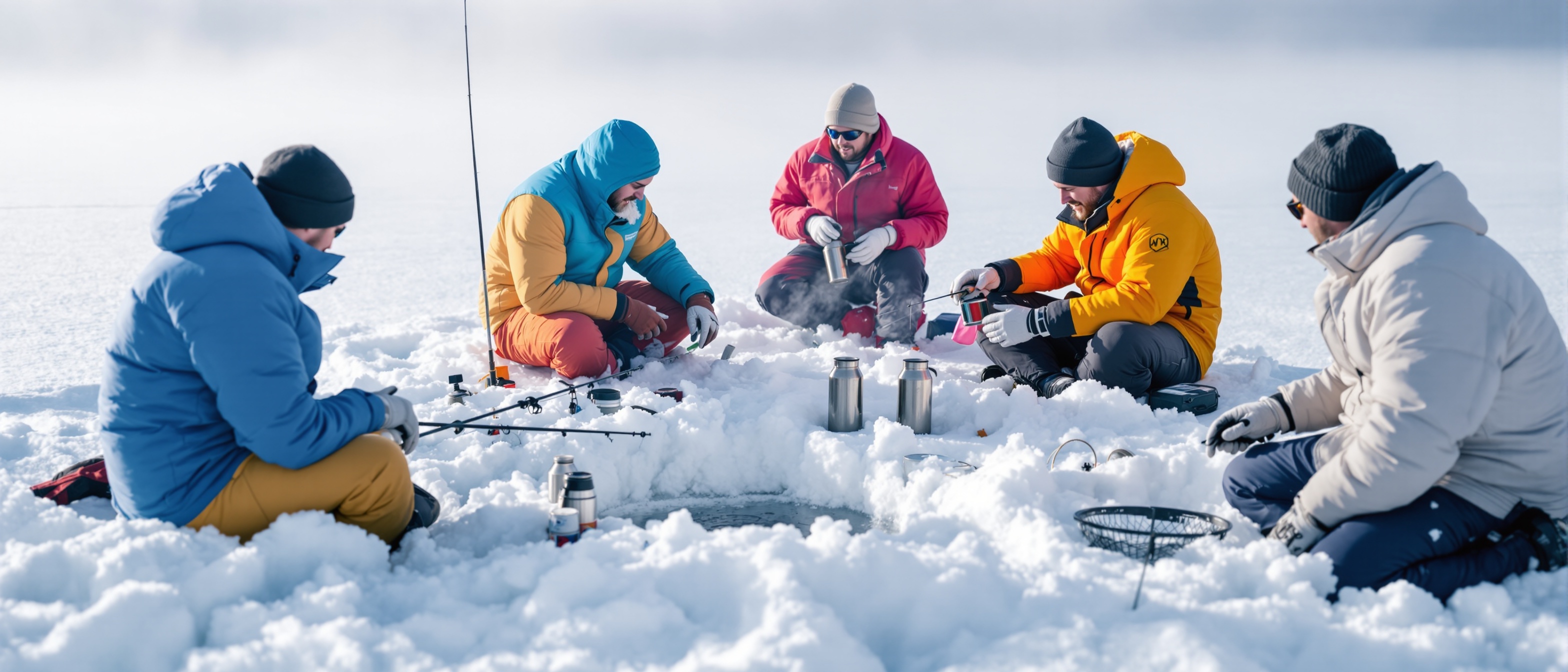
The complaint that recurs most often is not cold — it is overheating on the walk out and then chilling once you stop. Anglers who walk or pull a sled to their spot consistently rate side and pit vents higher than raw insulation weight. If you fish from a shelter and drive to it, the calculus reverses and you can size warmth up.
Published ice-thickness guidance is consistent across the northern states: roughly four inches of new clear ice for walking, and considerably more for a vehicle. A float suit does not change those numbers. It changes what happens after you have already misjudged them.
Final Verdict
If you fish natural ice at all, buy flotation. The cost gap over a plain insulated bib is now small enough that skipping it is hard to justify, and the Clam IceArmor Summit sits at the bottom of the float tier for exactly this reason. If you fish across a wide temperature range, Striker’s Climate with its removable 175g liner adapts better than any fixed-insulation suit. If you fish from a heated shelter you drive to, an insulated non-float bib like the Eskimo Keeper is a defensible saving. Whatever you buy, it is flotation assist and not a life jacket — carry ice picks, carry a rope, and check the ice yourself.
View Ice Fishing Suits on Amazon